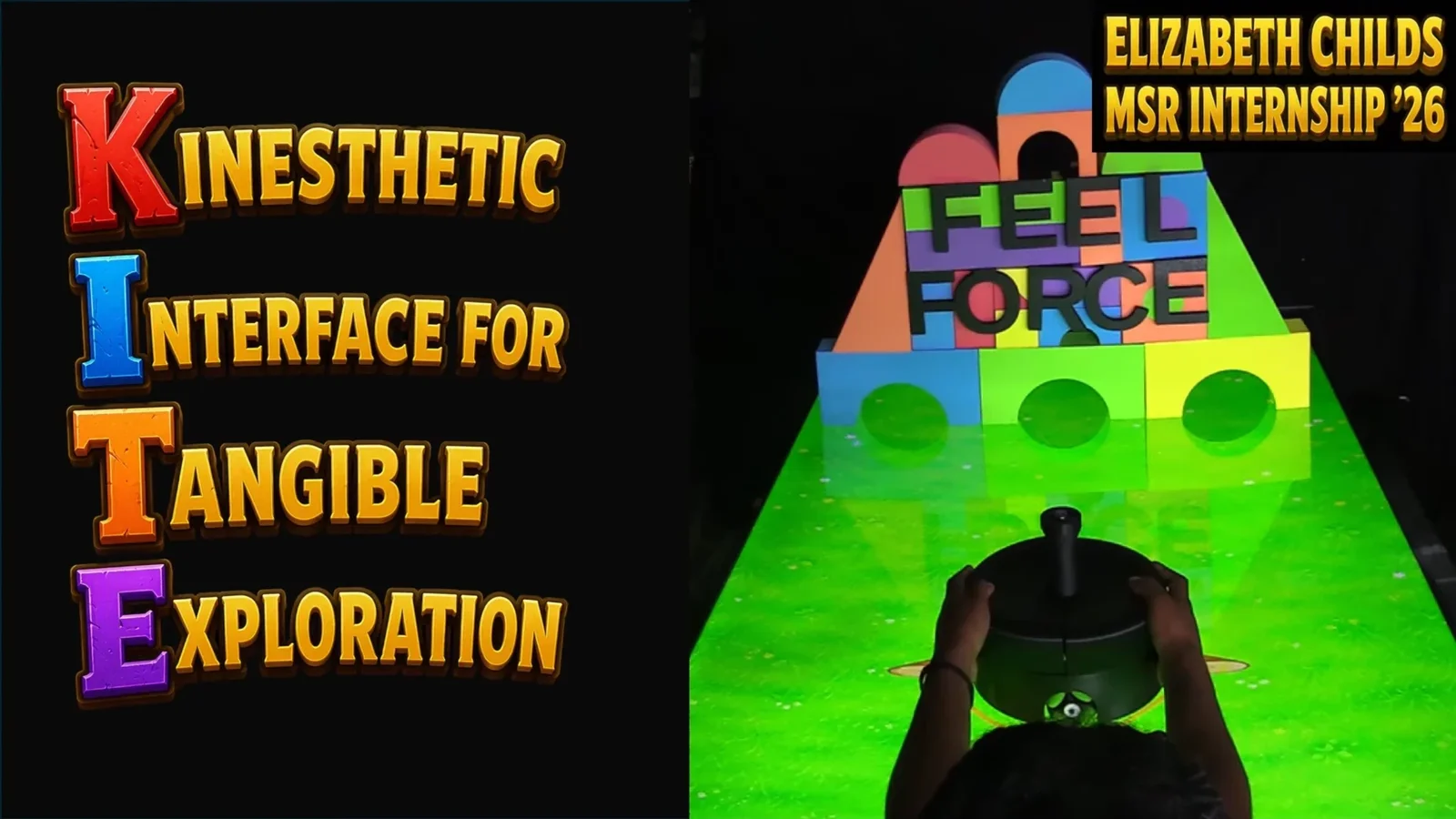
KITE: A Kinesthetic Interface for Tangible Exploration
Microsoft Research · Future Experiences Group
- Role
- Research intern. Designed and built the entire system, from the mechanical hardware, electronics, and motor control to the localization and the physics simulations.
- Mentors
- Sumit Basu and Scott Saponas, Microsoft Research
- Tools & techniques
- CAD, 3D printing, omni-wheel drivetrain design, motor integration and control, power electronics, embedded computing, sensor fusion, computer vision, haptic rendering, projected AR, and physics simulation.
Physics simulations can show forces like lift, tension, and electric fields, but learners can only watch them. KITE lets them feel those forces. It is a free-moving haptic robot that glides across a desk like a mouse and, when it meets a virtual object or force in the simulation, pushes back with multidirectional force and torque that line up with what is on screen. One device supports experiences across physics, from aerodynamics to chemistry.
Hardware Design
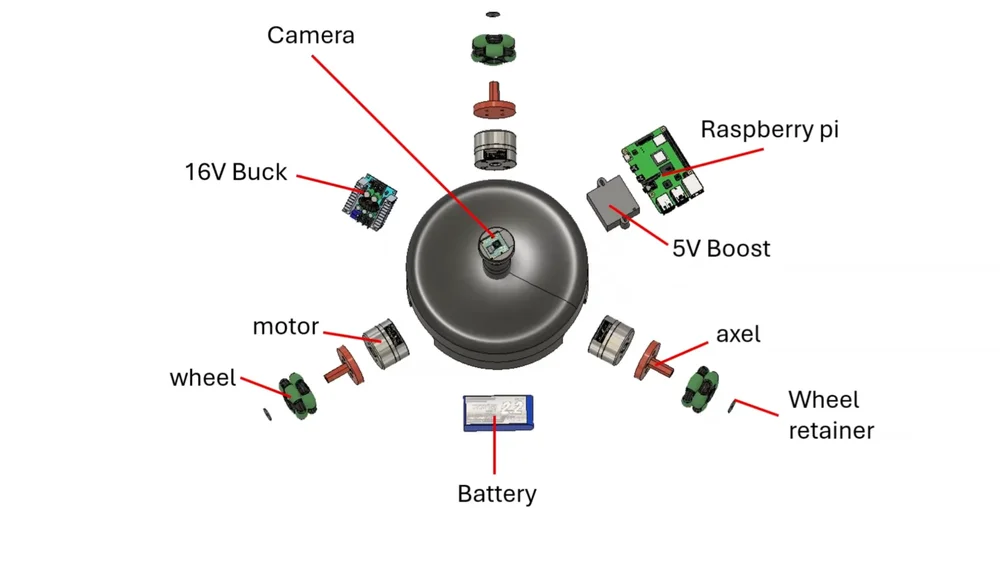
- Gearless actuation. Gearless motors drive omni wheels, so KITE can move and push in any direction. Custom motor control renders smooth forces and torques without the backlash and friction a geared drive would add.
- Hybrid localization. Overhead camera tracking gives KITE’s absolute position, and motor feedback fills in between camera updates, keeping force rendering precise and responsive.
- Self-contained body. An onboard camera, Raspberry Pi, battery, and buck and boost power converters all fit inside one compact housing.
Interaction Design
The physical device stays the learner’s main way of interacting. KITE moves freely until it meets something in the simulation, and the simulation reacts to where the learner moves it and how hard they push. The same robot supports a range of physics experiences:
- Feeling lift on an airfoil
- Pulling apart molecular bonds
- Exploring tidal forces and electric fields
- Stretching and compressing springs
- Comparing different forms of friction