Additive Assembly for 3D-Printed Microfluidics
Elizabeth Childs, Andrew Latchman, Andrew Lamont, Joshua Hubbard, Ryan Sochol
- Role
- Lead author. Led a project team with an undergraduate and a master’s student, designed the additive assembly approach and its printed fasteners, and ran the burst-pressure testing.
- Lab
- Bioinspired Advanced Manufacturing (BAM) Lab, University of Maryland. Advisor, Prof. Ryan D. Sochol
- Tools & techniques
- Multi-material PolyJet 3D printing, SolidWorks, design for manufacturing (integrated fasteners and seals), and empirical testing.
Multi-material 3D printing can produce intricate fluidic devices, but cleaning the support material out of enclosed channels is slow and often damages the part. Instead of printing the device closed, this work prints it as two open halves with built-in fasteners and seals, then fastens them together. The approach cut post-processing time by about 98%, and the assembled devices withstood burst pressures comparable to or higher than fully enclosed printed devices from prior work. It is a design-for-manufacturing solution: changing how a part is designed to remove a bottleneck in how it is made.
Concept and Design

The additive assembly methodology in this work consists of five key steps. First, a 3D model of a microfluidic system is sectioned into separated components such that any and all internal channels become unenclosed. As shown in the figure above, an enclosed microfluidic capacitor would be divided into two unenclosed halves. The capacitor would be printed with flexible (shown in black), rigid (shown in white), and sacrificial support (shown in yellow). Features that promote flexible-to-rigid interactions akin to O-rings and fastener elements are added along critical points for optimal fluidic sealing. The resulting parts are then PolyJet 3D printed with the unenclosed channels facing upward, such that the sacrificial support material is never deposited into the unenclosed channels (Fig. a). Next, the water-soluble support material is removed from the parts (Fig. b). Lastly, the fasteners with string-like extrusions – all printed in place (Fig. a,b) – are used to align the parts and then tightly seal the final assembly (Fig. c). Thereafter, the part can be used for microfluidic operations (Fig d).
Results
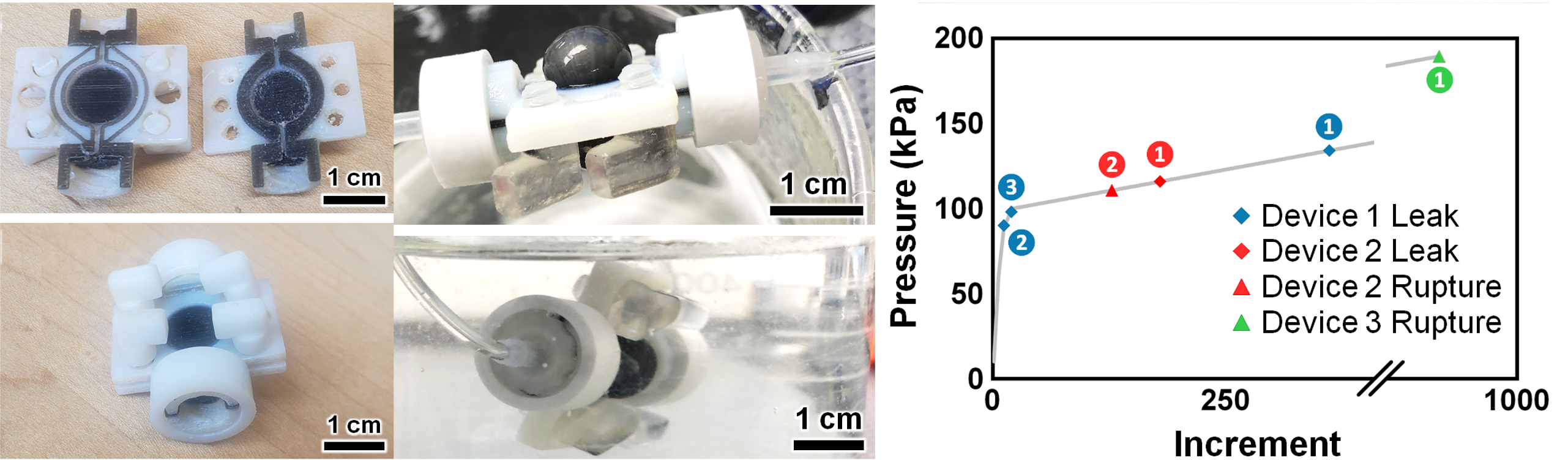
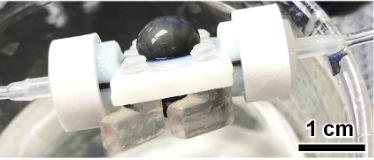
To investigate the sealing efficacy of the additive assembly strategy, we aligned the distinct PolyJet-printed parts, assembled them into a singular component using the printed fasteners, and performed burst-pressure experiments with three distinct devices. The resulting capacitor is shown on the left of the figure above before (top) and after (bottom) assembly. Once assembled, the microfluidic capacitor design results in visible inflation of the flexible diaphragm under an applied input pressure, as shown in the middle image (top). For the burst pressure test, each device was submerged in water (bottom) and monitored for two types of failure modes resulting in visible leakage (i.e., air bubble generation):
- assembly-associated leakage (from locations where the two distinct parts interact)
- diaphragm leakage/fracture, which is unrelated to the additive assembly process
Experimental results for the first device initially revealed effective assembly integrity for pressures up to 134 kPa; however, subsequent trials failed at lower pressures of 90 kPa and then 98 kPa (Right figure: blue data points. Note the numbers indicate the inflation pressure trial). A second device first exhibited assembly-based leakage at a slightly lower pressure of 116 kPa, but then maintained assembly integrity until one of the diaphragms failed at 111 kPa during the second trial (Right Figure: red data points). Experiments with a third device did not reveal any failures due to the additive assembly process as the device maintained internal pressures in excess of 189 kPa at which point a diaphragm ruptured (Right figure: green data points.). Despite differences in designs and printed material properties, the additive assembly results correspond to comparable and/or higher pressures than those reported in prior works for fully enclosed inkjet-printed 3D microfluidic capacitors (See paper for more details).