Physical Interfaces for Digital Systems
I combine mechatronics, embedded sensing, haptics, and augmented reality to give digital systems a physical form. My projects include a haptic robot for feeling simulated forces, a smartphone-enabled microscope, and a mechatronic tabletop game.
- KITE: Feeling Simulated Forces
- Smartphone-Enabled Microscope
- Mario vs. Sonic: A Mechatronic Tabletop Game
KITE: Feeling Simulated Forces
Microsoft Research
KITE turns physics simulations into something you can feel. It glides across the desk like a mouse until it meets a virtual object or force, then pushes back in line with what’s on screen. Learners can feel lift on an airfoil, pull a molecular bond apart, stretch a spring, and compare different kinds of friction with their own hands.
Tools & techniques: Haptic rendering, force feedback, simulation integration, and interaction design.
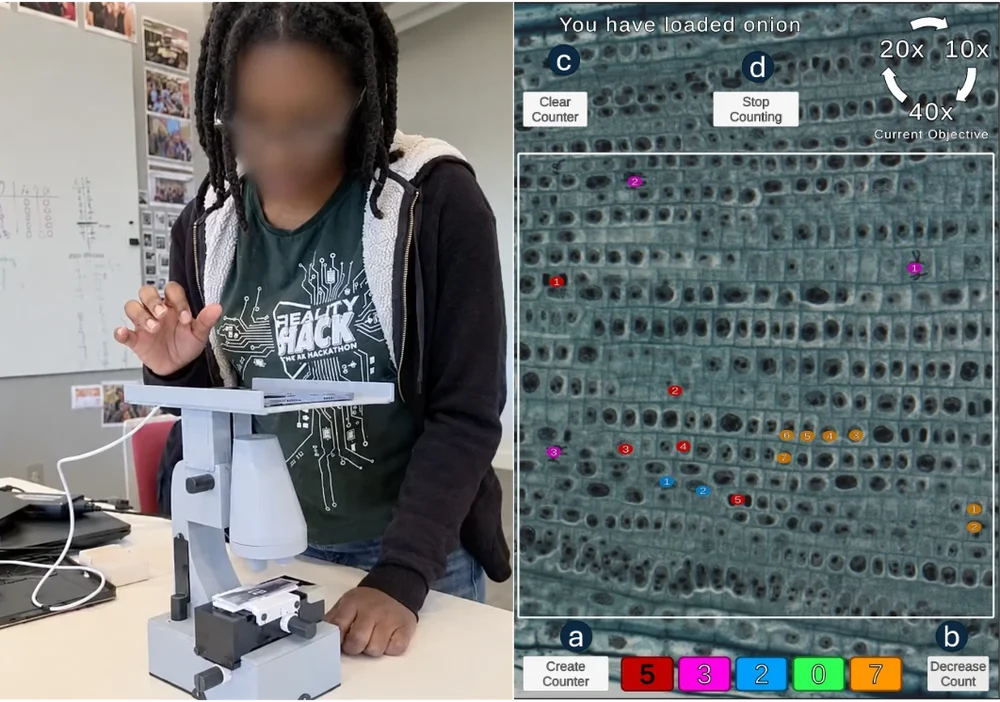
Smartphone-Enabled Microscope

A low-cost microscope built from 3D-printed parts and off-the-shelf electronics. Its real focus knob, objective turret, and slide stage are instrumented with encoders, magnetic detents, and potentiometers, so turning them drives high-resolution imagery on a connected smartphone. Students keep the physical habits of microscopy without the cost and fragility of lab optics.
Tools & techniques: Sensor integration, syncing hardware with a mobile app, 3D printing, and designing for low cost.
Mario vs. Sonic: A Mechatronic Tabletop Game
Mario and Sonic face off in a tabletop hockey game where the play is physical but the game is digital. Using buttons, players move and swing physical hockey sticks across the board, and beam-break sensors catch every goal so the electronics can keep score and react in real time. The mechanism and the game logic were designed together, so each physical play becomes a game event.
Tools & techniques: Arduino programming, servo actuation, beam-break sensing, 3D printing, and linking physical play to game logic.