Mechanical Design
I design and build custom hardware, from haptic, bio-inspired, and autonomous robots to soft robotics, multi-material 3D printing, CAD modeling, and machining. These skills in sensing, actuation, and fabrication enable custom physical inputs and outputs for tangible interactions.
Haptic Robotics
KITE: A Free-Moving Haptic Robot
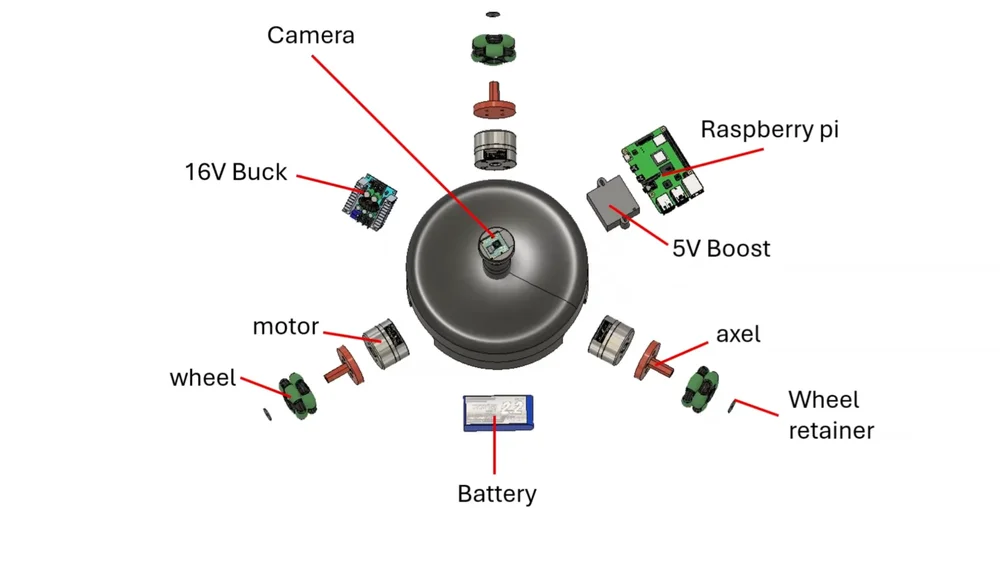
I designed the mechatronics for KITE, a free-moving haptic robot. Gearless motors drive omni wheels so it can move and push in any direction, and a hybrid localization system fuses overhead camera tracking with motor feedback to keep force rendering precise between camera updates. An onboard camera, Raspberry Pi, battery, and buck and boost power converters all fit inside one compact body.
Tools & techniques: CAD, 3D printing, omni-wheel drivetrain design, motor integration, power electronics, embedded computing, sensor fusion, and computer vision.
Traditional Robotics
Flic Flac Spider: A Somersaulting Bio-Inspired Robot
Most bio-inspired robots walk. We built ours to flip. The Flic Flac spider, a species discovered in Morocco, escapes predators by somersaulting with a flic-flac motion of its legs, and we recreated that gait in a robot driven by only four servos.
The challenge was to travel 35 body lengths in 2 minutes. Our robot covered the distance in 6 seconds, 20 times faster than required, and placed first out of 13 teams.
Tools & techniques: Teensy microcontroller programming, IMU orientation sensing, coordinated servo control, and gait design for a dynamic, non-walking locomotion strategy.
Mahogany: An Autonomous Ball-Herding Robot

Mahogany had to autonomously “herd sheep,” carrying balls from a loading area to a scoring area across a field with holes, without losing any along the way. Instead of building a gripper, we solved this mechanically with a laser-cut “playpen” that surrounds five balls at once, so the balls can’t escape the robot whatever path it drives.
It navigates with IR line sensors and a state machine that counts field intersections to find the goal.
Tools & techniques: Teensy programming, motor control, power electronics, sensor integration, 3D printing, laser cutting, and state-machine design.
Over-Sand Vehicle: Autonomous Fluid Sampling
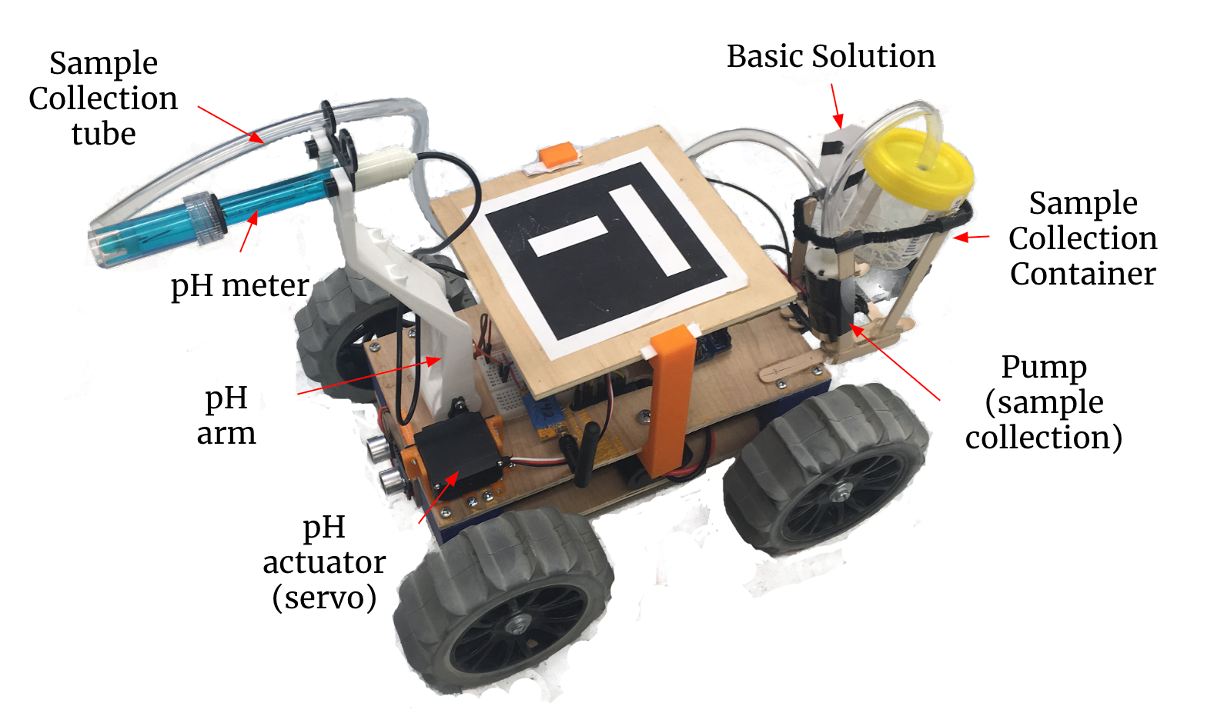 An autonomous robot that crosses sand, clears an obstacle wall, and reaches an acidic pool, where a 3D-printed arm samples the liquid and reads its pH before the robot neutralizes it with baking soda. When the motors couldn’t pivot in sand, we solved it in software with a closed-loop “wiggle” turn that keeps the wheels from digging in.
Tools & techniques: Arduino programming, closed-loop navigation, servo mechanisms, fluid sampling, pH sensing, and 3D printing.
Compliant and Multi-Material Design
Additive Assembly for 3D-Printed Microfluidics
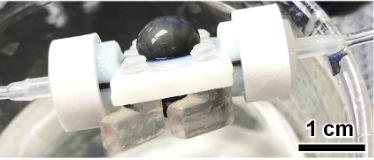 Multi-material 3D printing can produce intricate fluidic devices, but cleaning support material out of enclosed channels is slow and often damages the part. Instead of printing the device closed, we printed it as two open halves with built-in fasteners and seals, then fastened them together. This cut post-processing time by about 98%, and the assembled devices withstood burst pressures comparable to or higher than fully enclosed printed devices from prior work.
Tools & techniques: Multi-material 3D printing, SolidWorks, designing integrated fasteners and seals, and empirical testing.
Impact-Absorbing Feet for the Cassie Bipedal Robot
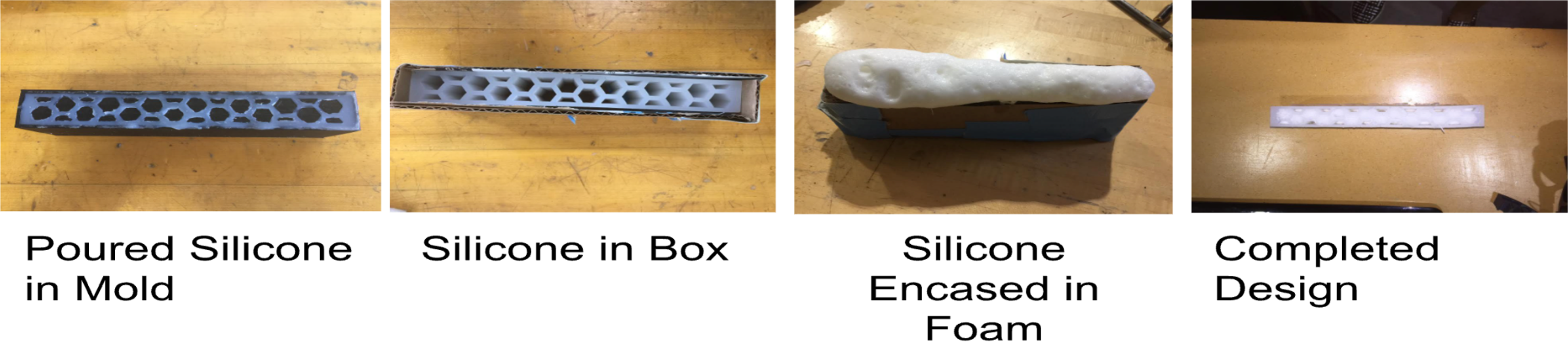 Cassie’s hard feet slammed into the ground with every step. I designed new feet that absorb impact while staying stiff enough for the robot’s balance control. After I tested cone, diamond, and honeycomb geometries in silicones, foams, and gels, the best design paired a silicone honeycomb with foam inserts. It cut peak impact force by over 47% and overall step impact by over 90%, with no changes to Cassie’s controller.
Tools & techniques: Silicone and foam manufacturing, material characterization, force-plate testing, and designing within the constraints of an existing control system.
Pneumatic Soft Robotic Fingers
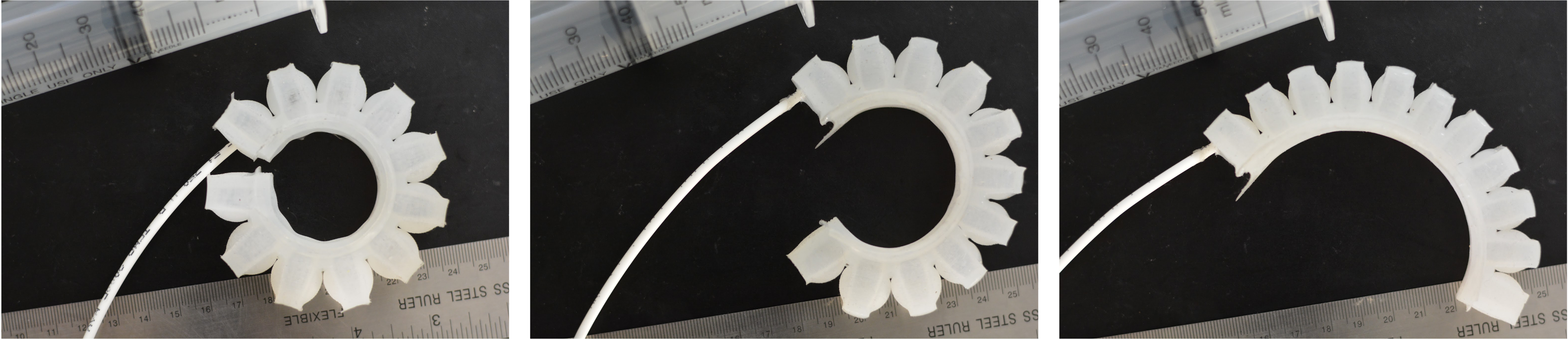 Soft fingers that bend when inflated with air. I fabricated several designs and measured where and how sharply each one curved at a given pressure, to learn how the geometry controls the motion.
Tools & techniques: Silicone mold manufacturing, pneumatic actuation, and parametric empirical characterization.
CAD and Manufacturing
Dirt Bike Engine Recreated from Specifications

Our team recreated a Yamaha YZ250F dirt bike from its original technical specifications. I modeled the tailpipe and kickstand (left) and created the animation of the full assembly (right).
Tools & techniques: SolidWorks, technical CAD from specifications, large assembly modeling, and animation.
Human-Powered Washing Machine
A washing machine that runs on human power instead of electricity, designed as a team entirely in CAD during the COVID-19 pandemic.
Tools & techniques: SolidWorks, mechanism design, and remote team-based design.
CNC-Machined Parts
 I designed and CNC machined a working whistle (left) and a magnetic stamp with a fitted cover (right).
Tools & techniques: CAD, CNC machining, and designing for tight-fit assemblies.